

The True Cost of Urology Devices: A Guide for Hospitals in Australia and New Zealand
Quick answer: what is the true cost of a urology device?
The true cost of a urology device is its cost per procedure, not its unit price. It includes reprocessing, repairs, downtime, stock availability, training and support. An Australian study found reusable flexible ureteroscopes lasted an average of 11 cases before major repair, adding $695 per case in repair costs alone.
Innovia Group is an Australian-owned medical device company based in Lane Cove West, Sydney. We supply a complete single-use endoscope range for kidney stone treatment, including rigid and flexible ureteroscopes and cystoscopes, plus stone retrieval baskets, ureteral access sheaths and urethral dilators, to hospitals and day surgeries across Australia and New Zealand.
Why doesn't the unit price show the true cost of a medical device?
When hospitals compare medical devices, the unit price is usually the first number on the table. It is also the easiest one to measure.
But anyone who has worked in theatre or procurement knows the true cost of a device shows up later. It appears in repair invoices, in lists delayed by missing stock, and in hours spent finding an alternative when something goes wrong.
At Innovia Group, we believe a cost-effective device is only cost-effective if it works for everyone involved: the hospital managing its budget, the clinician using it in theatre, and the patient waiting for care. That is why we take a holistic approach to supply.
What hidden costs affect urology devices in hospitals?
The purchase price is only one part of what a device costs a hospital. Four hidden costs often matter just as much.
- 1. Repairs and reprocessing. Reusable devices need cleaning, sterilising and maintenance between cases. When they break, repairs can be costly and the device is out of service while it is fixed.
- 2. Stock shortages. A device that is not on the shelf when the list starts can delay or cancel cases. Every cancelled case has a cost for the hospital and for the patient.
- 3. Time spent sourcing alternatives. When stock runs short or a supplier cannot respond, theatre and procurement staff spend hours finding a substitute. That time rarely appears on an invoice.
- 4. Gaps in training and support. A new device only performs as well as the team using it. Without ongoing training and someone local to call, even good technology becomes a frustration.
What does Australian research show about ureteroscopy costs?
Urology offers a clear example of why the unit price can mislead. Two Australian studies show how much cost sits outside the purchase price, and how quickly demand is growing.
Repairs add up fast. A Melbourne hospital study tracked seven new reusable flexible ureteroscopes across 234 kidney stone procedures over 30 months. The scopes lasted an average of 11 cases before their first major damage. Repairs totalled more than $162,000, adding an average of $695 to every case before purchase price or reprocessing.
Demand keeps rising. A 2026 study in the ANZ Journal of Surgery analysed 30 years of Medicare data on stone surgery. Stone surgery rates rose from 26 to 89 per 100,000 people between 1994 and 2024, and ureteroscopy volumes grew sevenfold. By 2024, shockwave lithotripsy accounted for just 7.4% of stone procedures.
More endoscopic cases mean more pressure on scopes, stock and theatre time. The authors note that hospitals will need to plan workforce, theatre time and equipment to match. In that environment, a device's true cost per case matters more than ever.
How does Innovia Group supply cost-effective urology products?
We believe cost-effective supply only works when four things work together. Get one wrong, and the savings from the others can disappear.
1. The right products
We keep a curated urology portfolio, not a catalogue. It includes single-use flexible and rigid ureteroscopes, single-use flexible and rigid cystoscopes, stone retrieval baskets, ureteral access sheaths and urethral dilators. Each product is selected for quality, clinical performance and value, so hospitals are not choosing between a good price and a device clinicians trust.
2. Reliable local supply
We hold stock locally and supply hospitals and day surgeries across Australia and New Zealand, with forecasting and demand planning so devices are on the shelf when the list starts. Local stock means no waiting on overseas shipments during busy periods such as summer stone season.
3. Support after the sale
Our local technical, sales and service team supports hospitals from the first evaluation to ongoing training in theatre. When a question comes up mid-list, there is someone in the same time zone to call.
4. Regulatory confidence
Our team understands TGA and ARTG requirements, so hospitals can introduce new products with confidence that they meet Australian standards.
Can kidney stone treatment be done entirely with single-use scopes?
Yes. Innovia Group supplies a complete single-use endoscope range for stone treatment, so a whole procedure can run on single-use scopes without a traditional video stack.
A typical procedure uses three single-use scopes in sequence:
- 1. Single-use rigid cystoscope for stent removal and guidewire placement.
- 2. Single-use rigid or flexible ureteroscope to treat the stone.
- 3. Single-use rigid cystoscope again for stent placement.
Each scope arrives sterile and ready to open, with no reprocessing between cases and no repair downtime.
Why this matters for new and growing hospitals
Setting up a urology theatre traditionally means investing in a video stack, reusable scopes and reprocessing capacity before the first case. A complete single-use range can reduce the upfront equipment a new hospital or day surgery needs to start offering stone treatment.
The single-use endoscope range
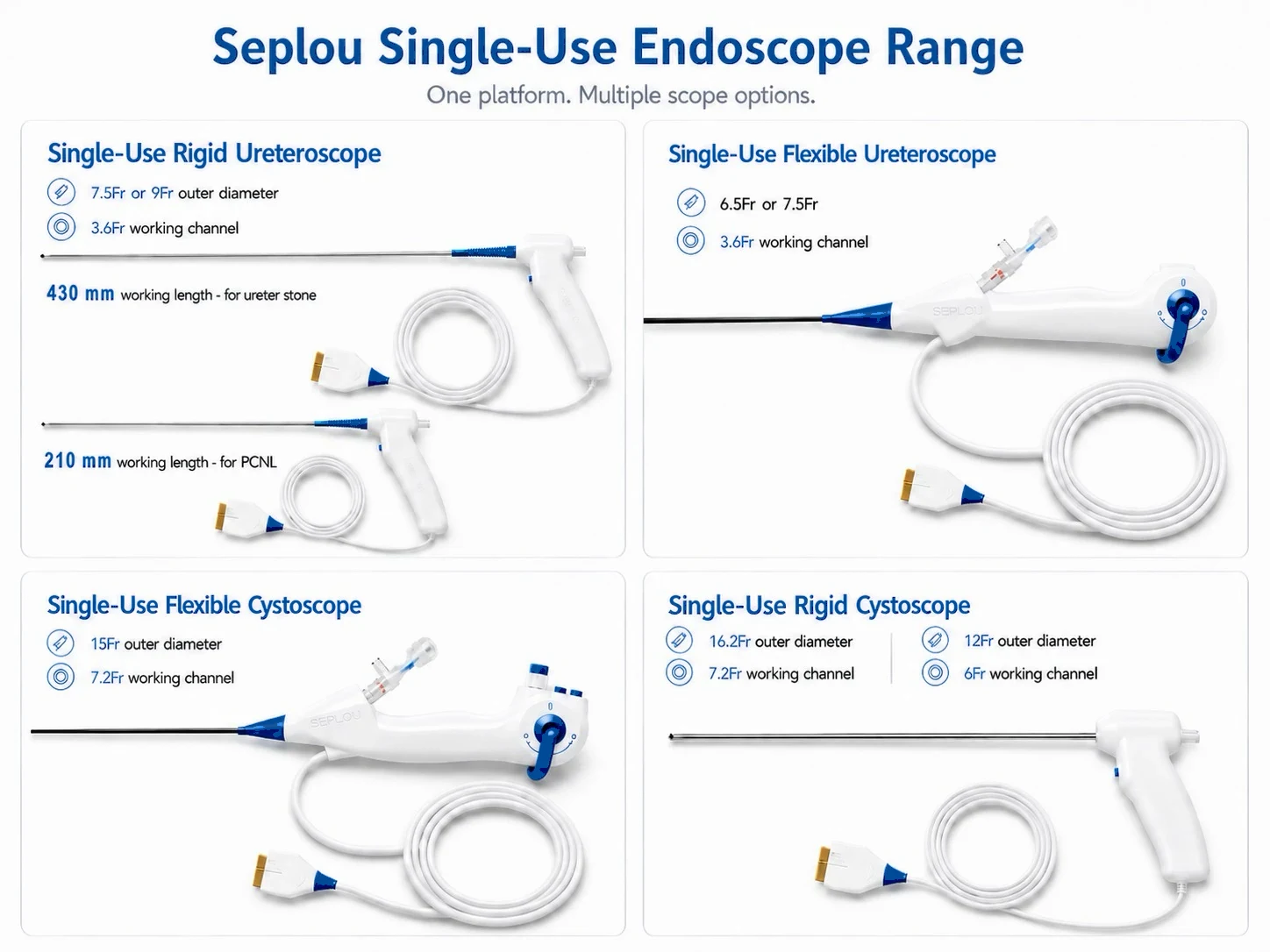
The rigid ureteroscope is 7.5 Fr or 9 Fr with a 3.6 Fr working channel, in a 430 mm working length for ureteral stones and a 210 mm length for PCNL. The flexible ureteroscope is 6.5 Fr or 7.5 Fr, also with a 3.6 Fr channel. On the bladder side, the flexible cystoscope is 15 Fr with a 7.2 Fr channel, and the rigid cystoscope comes in 16.2 Fr with a 7.2 Fr channel or 12 Fr with a 6 Fr channel.
Free checklist: 12 questions to find the true cost of a urology device
Use these questions when you next review a device or supplier. They help procurement and clinical teams compare the full cost, not just the price.
Product
- What does the device cost per procedure, not just per unit?
- Is it reusable or single-use, and what does reprocessing cost each case?
- How many cases does it typically complete before it needs repair?
Supply
- Where is the stock held, and how long does a delivery take?
- What happens if demand spikes, such as during summer stone season?
- How often have cases been delayed by stock shortages in the past year?
Support
- Who do clinicians call if a question comes up mid-list?
- Is training ongoing, or only at the time of purchase?
- How long does a repair or replacement take, and is a loan device available?
Compliance
- Is the device included on the ARTG for its intended use?
- Does the supplier understand TGA requirements and local standards?
- Is product information provided clearly for clinical and procurement teams?
Feel free to share this checklist with your team or link to it from your own resources.
One partner, the whole picture
A lower price only becomes real value when the right product, reliable supply, local support and regulatory confidence come together. That is the standard we hold ourselves to at Innovia Group, for every hospital we supply in Australia and New Zealand.
If your department is reviewing its devices or suppliers, we would be glad to talk it through. Contact our team or explore our urology range.
About Innovia Group
Innovia Group is an Australian-owned medical device manufacturer and distributor based in Lane Cove West, Sydney. We supply private and public hospitals, day surgeries and specialist clinics across Australia and New Zealand. Our focus is cost-effective urology consumables, including ureteroscopes, cystoscopes, stone retrieval baskets and ureteral access sheaths, plus laser safety eyewear for theatre staff and patients.
Innovia Group supplies medical devices intended for use by qualified healthcare professionals. 36/2 Chaplin Drive, Lane Cove West NSW 2066. Phone +61 2 8313 5478. Email info@innoviagroup.com.au.
References
1. Hennessey DB et al. Single-use disposable digital flexible ureteroscopes: an ex vivo assessment and cost analysis. BJU International, 2018.
2. Razi B, Fung C, Palma CA, Woo HH, Bariol S. From Shocks to Scopes: National Trends in Stone Surgery in Australia. ANZ Journal of Surgery, 2026.
Quick answers
Where can hospitals buy urology products in Australia?
Innovia Group supplies urology products to public and private hospitals, day surgeries and specialist clinics across Australia. We are based in Lane Cove West, Sydney, hold stock locally and provide local technical, sales and service support.
Does Innovia Group supply hospitals in New Zealand?
Yes. Innovia Group supplies hospitals and day surgeries in both Australia and New Zealand, with support from our local team.
What urology products does Innovia Group supply?
Our urology range includes a complete single-use endoscope range for stone treatment: single-use rigid and flexible ureteroscopes and single-use rigid and flexible cystoscopes. It also includes stone retrieval baskets, ureteral access sheaths and urethral dilators. We also supply laser safety eyewear for theatre staff and patients.
What sizes of flexible ureteroscope are available?
Innovia Group supplies single-use flexible ureteroscopes in 6.5 Fr and 7.5 Fr, and single-use rigid ureteroscopes in 7.5 Fr and 9 Fr, with 430 mm and 210 mm working lengths.
Do single-use endoscopes need a video stack?
No. Innovia Group's single-use endoscope range works without a traditional video stack, so a complete kidney stone procedure can be performed with single-use rigid and flexible scopes.
Are single-use ureteroscopes cost-effective?
It depends on the department. An Australian study found that, depending on purchase price, single-use scopes may cost less than the cumulative repair and maintenance costs of reusable scopes. Case volume, repair history and reprocessing capacity all affect the answer.
How do I get pricing for urology products?
Pricing is available on application. Contact our team for a quote tailored to your department's case volume and product mix.
Related products
Single-Use Ureteroscopes
Digital flexible scopes in 6.5 Fr, 7.5 Fr and 9.0 Fr, all 285 degree deflection.
View productSingle-Use Rigid Cystoscope
Supplied sterile as a complete kit for routine cystoscopy, guidewire placement and stent procedures.
View productUrology range
The full Seplou range distributed in Australia and New Zealand.
View product