

Do You Need Different Laser Goggles for Holmium and Thulium?
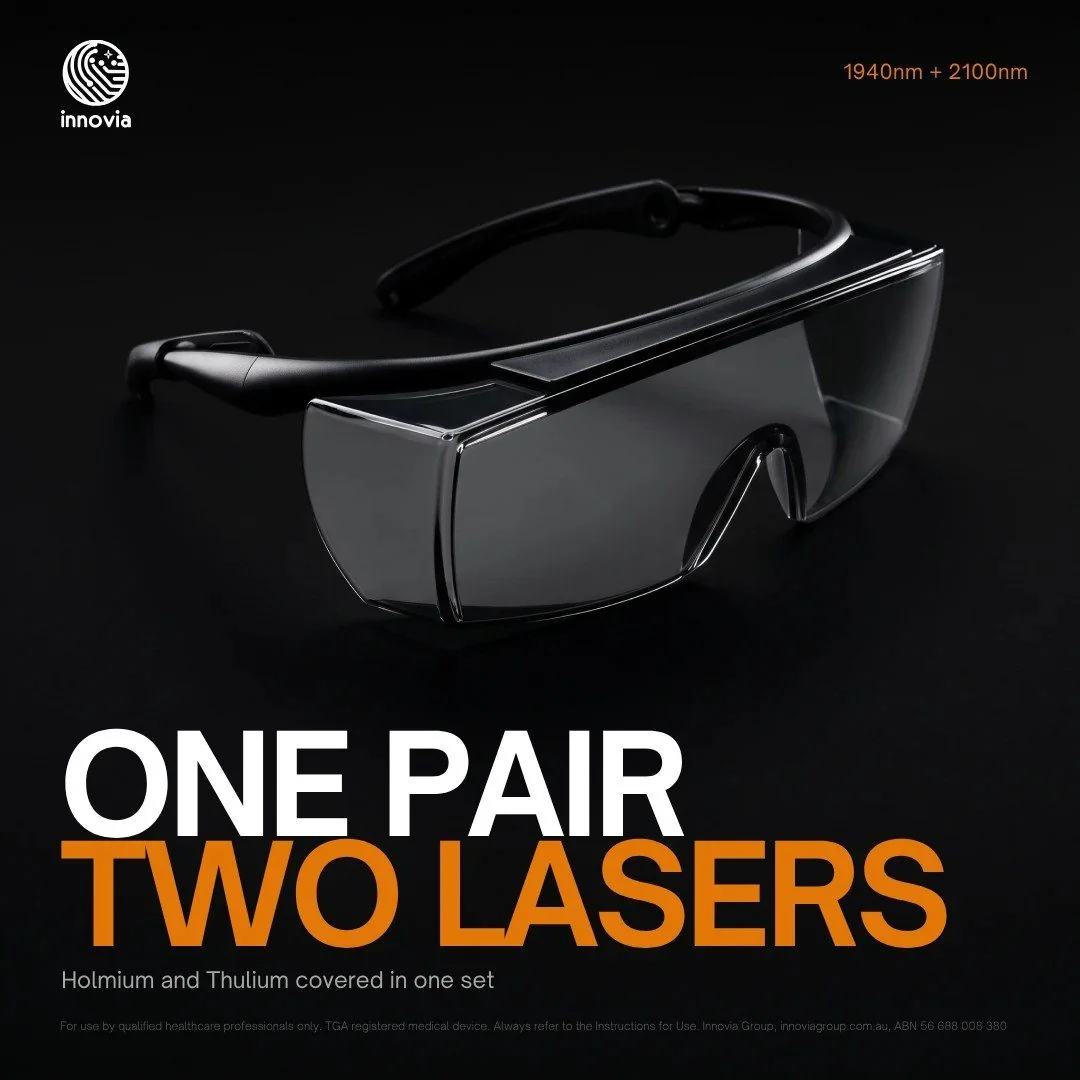
Thulium fibre lasers have moved into a lot of urology departments that have run Holmium for years, often alongside it rather than replacing it. The question that follows is a practical one: does the eyewear already in the theatre cover the new laser, or is a second set needed?
The honest answer is that it depends entirely on what is marked on the pairs you already own, and that plenty of departments have assumed wrongly in both directions.
The two wavelengths
Holmium YAG operates at 2100 nm. Thulium fibre operates at approximately 1940 nm. They sit reasonably close together in the infrared, close enough that eyewear designed for this part of the spectrum will often cover both, and far enough apart that it is not safe to assume so.
Laser eyewear is not rated for named lasers. It is rated for a wavelength range, at a stated optical density, and both figures are marked on the frame. A pair marked for a range that spans 1940 nm and 2100 nm covers both. A pair marked narrowly around 2100 nm may not cover Thulium at all.
Where departments get caught out
Two failure modes come up repeatedly, and they are opposites.
The first is assuming the existing Holmium eyewear covers the new Thulium laser because the numbers look close. If the marked range stops short, it does not, and nothing about wearing the pair will reveal the gap.
The second is the inverse, and it is the more dangerous one. A department buys a separate set for Thulium, then runs both lasers with two visually similar sets of eyewear in the same theatre. Now the risk is not coverage, it is selection: somebody picks up the wrong pair mid list. Two sets that look alike and protect differently is a worse position than one set that covers everything, and it is how most real incidents happen.
What to check on the pairs you already own
Before buying anything, read what is on the eyewear in your theatre:
- The marked wavelength range, and whether it spans both 1940 nm and 2100 nm
- The optical density across that range, which is not always constant
- Whether the marking is still legible at all
- Whether every pair in the drawer carries the same marking, or whether the set has drifted over the years
That last point surprises people. Eyewear is usually bought in batches over time, and a drawer that looks like one set is often three different specifications that happen to look similar.
The case for one pair covering both
Where a single pair genuinely covers both wavelengths, the argument for standardising on it is not primarily about cost. It is that there is no wrong pair to pick up. Nobody has to check which laser is running before choosing eyewear, and no second set has to be kept separate, labelled and policed.
Our own laser safety eyewear is rated 1900 to 3000 nm at OD 4+, rising to OD 5+ across 2000 to 2300 nm where Holmium sits. That range covers Thulium at approximately 1940 nm and Holmium at 2100 nm in a single pair. It is certified to CE EN207, has 55% visible light transmission so staff can see the field, and is sized to be worn over prescription glasses.
What it does not cover
Worth being explicit, because this is the mistake we most want to prevent: eyewear rated for 1900 to 3000 nm is a surgical laser product. It does not protect against the much shorter wavelengths used by aesthetic laser devices, typically in the 500 to 1100 nm region. If your site runs both surgical and aesthetic lasers, those are genuinely different protection requirements and should never be treated as interchangeable.
Patient eye protection is a separate question again. Patient shields are fully opaque rather than tinted, and ours are rated OD 7+ across 200 to 11000 nm, which does span both surgical and aesthetic wavelengths.
If you are not certain
This is not a question to resolve by assumption. If you are unsure whether the eyewear in your theatre covers the lasers on your list, send us the marked wavelength range off your existing pairs and the lasers you run, and we will tell you straight whether they match.
Quick answers
Can one pair of laser goggles cover both Holmium and Thulium?
Yes, provided the marked wavelength range spans both. Holmium YAG runs at 2100 nm and Thulium fibre at approximately 1940 nm, so eyewear marked for a range covering both wavelengths at an adequate optical density will protect against each. Eyewear marked narrowly around 2100 nm may not cover Thulium.
What wavelength is a Thulium fibre laser?
Approximately 1940 nm. Holmium YAG operates at 2100 nm. Both sit in the infrared, close enough that eyewear designed for this region often covers both, but close enough also that departments wrongly assume it without checking the marking.
Is it safer to have two separate sets of laser goggles?
Usually not. Two visually similar sets that protect differently introduce a selection risk: someone picks up the wrong pair mid list. Where a single pair genuinely covers both wavelengths, standardising on it removes that risk entirely because there is no wrong pair to choose.
What does OD 4+ mean on laser goggles?
OD stands for optical density, and it describes how much the filter attenuates light at a given wavelength. The scale is logarithmic: OD 4 means the transmitted energy is reduced to one ten thousandth, OD 5 to one hundred thousandth, and OD 7 to one ten millionth. The figure is only meaningful alongside the wavelength range it applies to, because optical density is rarely constant across a filter. A pair marked OD 4+ across one band and OD 5+ across another is normal.
Do we still need laser goggles if the fibre is inside a ureteroscope?
Yes. Working through an endoscope reduces the likelihood of a stray beam but does not eliminate it. Fibres can fracture, the scope can be withdrawn while the laser is armed, and energy can be reflected off instruments. Standard practice is that everyone in the room wears appropriate protection whenever the laser is in a state where it can fire, not only while it is firing.
How many pairs of laser goggles does a theatre need?
Enough for every person who will be in the room while the laser is armed, plus spares. In practice that usually means the surgeon, the scrub nurse, the circulating nurse and the anaesthetist as a minimum, before accounting for observers, students and reps. Theatres that hold only two or three pairs tend to discover the shortfall at the least convenient moment, and a pair that has to be shared between cases gets handled far more and scratches sooner.
Can laser goggles be worn over prescription glasses?
Some can. Eyewear sized to fit over prescription glasses is usually described as an over-spec or fit-over design, with a wider frame and integrated side shields. It matters more than it sounds: where the only eyewear available does not fit over glasses, staff end up choosing between seeing the field properly and being protected, and that is not a choice anyone should be making mid list.
Do laser goggles sold in Australia have to meet a particular standard?
Laser eye protection is commonly certified to the European standard EN207, which is why you will see a CE mark and an LB rating on the frame alongside the wavelength range and optical density. Separately, medical devices supplied in Australia must generally be included in the Australian Register of Therapeutic Goods unless an exemption applies. Ask any supplier for the declaration of conformity and, where applicable, the ARTG number. A supplier who cannot produce documentation for what is marked on the frame is worth questioning.
Will surgical laser goggles protect against an aesthetic laser?
No. Eyewear rated for 1900 to 3000 nm is designed for Holmium and Thulium surgical lasers. Aesthetic laser devices operate at much shorter wavelengths, typically 500 to 1100 nm, and surgical laser eyewear offers no protection there. They are different protection requirements and must not be treated as interchangeable.